CLAMS: Cluster Ambiguity Measure for Estimating Perceptual Variability in Visual Clustering
Abstract
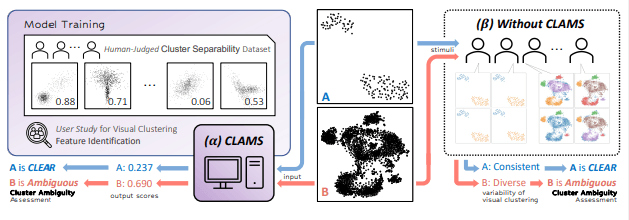
Visual clustering is a common perceptual task in scatterplots that supports diverse analytics tasks (e.g., cluster identification). However, even with the same scatterplot, the ways of perceiving clusters (i.e., conducting visual clustering) can differ due to the differences among individuals. Although such perceptual variability casts doubt on the reliability of data analysis based on visual clustering, we lack a systematic way to efficiently assess this variability. In this research, we study perceptual variability in conducting visual clustering, which we call "Cluster Ambiguity". To this end, we introduce "CLAMS", a data-driven visual quality measure for automatically predicting cluster ambiguity in monochrome scatterplots. We first conduct a qualitative study to identify key factors that affect the visual separation of clusters (e.g., proximity or size difference between clusters). Based on the study findings, we deploy a regression module that estimates the human-judged separability of two clusters. Then, CLAMS predicts cluster ambiguity by analyzing the aggregated results of all pairwise separability between clusters that are generated by the module. CLAMS outperforms widely-used clustering techniques in predicting ground truth cluster ambiguity. Meanwhile, CLAMS exhibits performance on par with human annotators. We conclude our work by presenting two applications for optimizing and benchmarking data mining techniques using CLAMS.
Resources
 PDF
PDFCitation
@ARTICLE{10308641,
  author={Jeon, Hyeon and Quadri, Ghulam Jilani and Lee, Hyunwook and Rosen, Paul and Szafir, Danielle Albers and Seo, Jinwook},
  journal={IEEE Transactions on Visualization and Computer Graphics},
  title={CLAMS: A Cluster Ambiguity Measure for Estimating Perceptual Variability in Visual Clustering},
  year={2024},
  volume={30},
  number={1},
  pages={770-780},
  keywords={Visualization;Task analysis;Reliability;Benchmark testing;Data analysis;Complexity theory;Clustering algorithms;Cluster;scatterplot;perception;cluster analysis;cluster ambiguity;visual quality measure},
  doi={10.1109/TVCG.2023.3327201}
}