Discrepancies in Mental Workload Estimation: Self-Reported versus EEG-Based Measures in Data Visualization Evaluation
Abstract
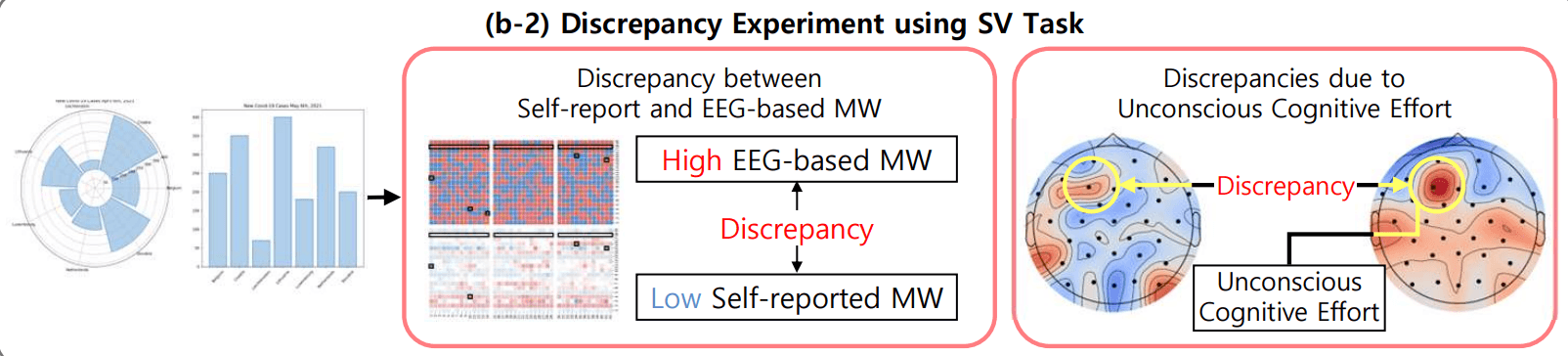
Accurate assessment of mental workload (MW) is crucial for understanding cognitive processes during visualization tasks. While EEG-based measures are emerging as promising alternatives to conventional assessment techniques, such as self- report measures, studies examining consistency across these different methodologies are limited. In a preliminary study, we observed indications of potential discrepancies between EEG- based and self-reported MW measures. Motivated by these preliminary observations, our study further explores the discrep- ancies between EEG-based and self-reported MW assessment methods through an experiment involving visualization tasks. In the experiment, we employ two benchmark tasks: the Visualiza- tion Literacy Assessment Test (VLAT) and a Spatial Visualization (SV) task. EEG signals are recorded from participants using a 32-channel system at a sampling rate of 128 Hz during the visualization tasks. For each participant, MW is estimated using an EEG-based model built on a Graph Attention Network (GAT) architecture, and these estimates are compared with conventional MW measures to examine potential discrepancies. Our findings reveal notable discrepancies between task difficulty and EEG-based MW estimates, as well as between EEG-based and self-reported MW measures across varying task difficulty levels. Additionally, the observed patterns suggest the presence of unconscious cognitive effort that may not be captured by self- report alone.
Citation
@misc{yim2025discrepanciesmentalworkloadestimation,
      title={Discrepancies in Mental Workload Estimation: Self-Reported versus EEG-Based Measures in Data Visualization Evaluation},
      author={Soobin Yim and Sangbong Yoo and Chanyoung Yoon and Chanyoung Jung and Chansoo Kim and Yun Jang and Ghulam Jilani Quadri},
      year={2025},
      eprint={2507.09262},
      archivePrefix={arXiv},
      primaryClass={cs.HC},
      url={https://arxiv.org/abs/2507.09262}
}